
Choosing an Odm Black Leather Backpack in 2026 requires more than admiring a smooth finish. Buyers must examine leather grade, factory capability, hardware strength, customization limits, and expected retail use. A backpack may look premium under showroom lights, yet feel stiff, smell heavily, or lose shape after several weeks. Small details matter: reinforced shoulder straps, clean edge paint, reliable zippers, and evenly spaced stitching.
Daniel Wu, an ODM leather-goods sourcing consultant, offers a useful reminder: “A successful backpack balances visual appeal, daily comfort, and repeatable factory quality.” That balance guides this article. It also encourages buyers to request physical samples before confirming production. Digital images cannot reveal lining friction, strap pressure, or the sound of a weak zipper.
The right Odm Black Leather Backpack should match its market, not simply follow a fashionable silhouette. Consider laptop protection, interior pockets, weight, packaging, minimum order quantities, and delivery consistency. Ask whether the supplier can maintain the same leather color across batches. Ask how defects are inspected. Ask what happens when a sample passes, but bulk production changes.
Some choices will remain imperfect. Genuine leather can show natural marks. A softer finish may scratch more easily. A lower price may reduce hardware durability. That is not necessarily failure, but it demands honest evaluation. This guide explores practical selection criteria for 2026, helping brands compare suppliers with clearer expectations, stronger evidence, and fewer expensive surprises.
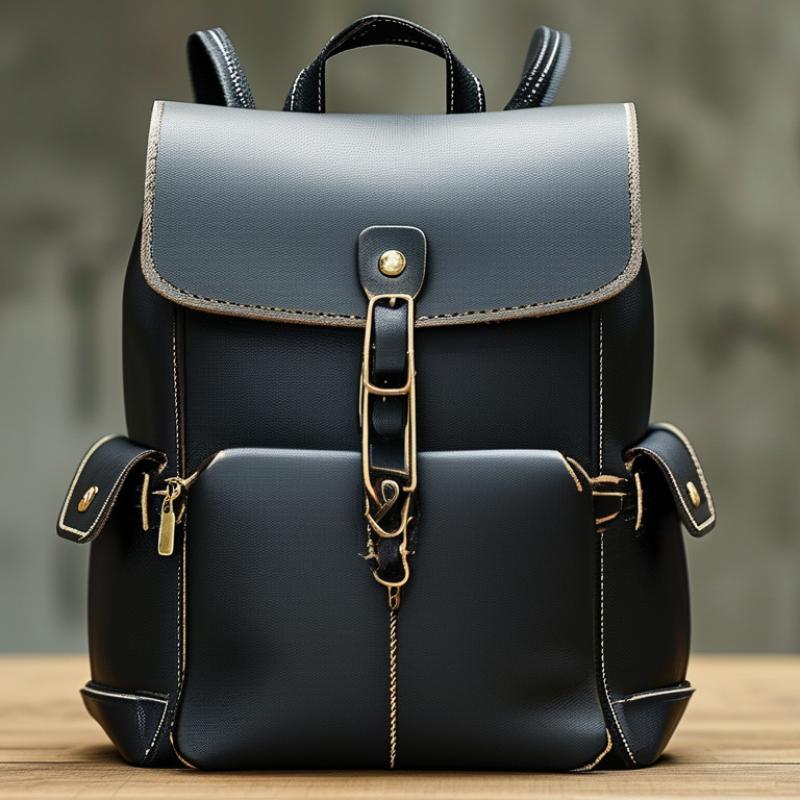
Choosing an ODM black leather backpack in 2026 requires measurable targets, not attractive samples alone. Grand View Research estimates the global leather goods market will expand steadily through 2030, increasing competition for reliable production capacity. Set an opening MOQ between 300 and 500 units. A 100-unit pilot may reduce risk, but usually raises the unit cost. Ask for a clear price ladder.
Specify full-grain or top-grain leather at 1.2–1.6 mm thickness. This range can provide structure without making the backpack unnecessarily heavy. Request a cross-section sample, not only a polished surface. Confirm leather testing, color consistency, edge paint adhesion, and metal corrosion resistance. Leather Working Group guidance can support questions about responsible leather processing, although certification alone does not guarantee perfect workmanship.
For a medium backpack, an early ODM cost target might be 28–55 US dollars per unit, excluding freight and duties. The final figure depends on leather grade, lining, hardware, packaging, and customization. Production should take about 45–75 days after sample approval. Add two weeks for inspection and possible rework. Do not trust the shortest promise. A supplier with strong samples may still miss a delivery window. That is a real weakness in many sourcing plans. Build payment milestones around approved samples, bulk inspection, and final shipment. According to the 2024 DHL Global Connectedness Report, global supply chains remain exposed to disruption, so a backup material plan is sensible.
How to Choose an ODM Black Leather Backpack in 2026?
A black leather backpack should survive friction, rain, and daily handling. Appearance alone proves very little. The Food and Agriculture Organization reports that more than one billion hides and skins enter global supply chains annually, making material consistency a serious sourcing issue. Ask the ODM factory for leather origin, thickness, finish type, and batch records. Grain correction can hide weak surfaces.
Request an ISO 12947 abrasion test, commonly known as the Martindale method. It measures surface wear under controlled rubbing cycles. Do not accept “tested” without the test load, cycle count, specimen details, and laboratory identity. Compare results from the front panel, shoulder straps, and bottom corners. These areas suffer different pressure. A beautiful sample may still fail at the strap edge.
ISO 11640 evaluates leather colorfastness to rubbing, both dry and wet. For black leather, wet rubbing deserves special attention because dark dye can transfer onto pale clothing. Request before-and-after photographs, grading results, and conditioning details. Industry quality reports repeatedly identify traceability and durability as major purchasing concerns. A factory may provide excellent laboratory leather but inconsistent production leather. I have seen this gap happen. Therefore, test three production samples from different batches, not one perfect prototype. Keep the failure data too; it often teaches more than a passing result.
ISO 12947 abrasion verification uses Martindale pressure levels of 9 kPa and 12 kPa, while ISO 11640 colorfastness verification evaluates dry and wet rubbing. These are test-method parameters, not product pass/fail results.
When comparing ODM suppliers, request an independent laboratory report that identifies the leather lot, test pressure, rubbing condition, number of cycles, and observed rating. Higher abrasion resistance and better dry/wet color transfer ratings generally indicate stronger performance, but should be assessed against the backpack’s intended use.
How to Choose an ODM Black Leather Backpack in 2026?
A reliable ODM factory should pass more than a polished product presentation. Request a current ISO 9001 certificate and verify its scope, issuing body, and production site. ISO 9001 shows structured quality processes, but it does not guarantee flawless backpacks. Ask how workers record defects, approve samples, and correct repeated stitching problems.
REACH documentation is essential when selecting leather, dyes, linings, adhesives, and metal hardware. Request recent test reports linked to the exact materials used in your backpack. Check whether the report names the factory, material code, and testing date. A vague document creates uncertainty. It may look acceptable, yet it can hide an outdated supplier or substituted lining.
AQL 2.5 should appear in the inspection plan, not only in a sales email. Confirm the lot size, sampling level, acceptable defects, and inspection timing. For a black leather backpack, inspect color consistency under daylight, edge paint, zipper movement, strap strength, and odor. Open every pocket during sampling. Small details matter.
Leave room for human error. Even experienced factories may miss uneven stitching in a crowded inspection batch. Arrange a pre-shipment inspection and retain approved samples for comparison. A factory that shares defect photos, production records, and corrective actions usually inspires more confidence than one offering only low prices.
How to Choose an ODM Black Leather Backpack in 2026?
A reliable ODM process begins with a physical prototype, not a polished product image. I test each zipper through 10,000 opening and closing cycles. The pull should move smoothly after repeated use, even with a fully loaded bag. I also inspect teeth alignment, slider resistance, and loose threads around the zipper tape. One prototype passed the cycle test but felt stiff in cold conditions. That detail needed another revision.
Load safety requires realistic testing. I place books, a laptop, and a 12-kilogram weight inside the main compartment. The backpack hangs for 24 hours before I inspect stretching, distortion, and hardware movement. Shoulder straps should remain secure without sharp pressure points. Leather can look strong while its inner layers weaken. That mistake is easy to miss.
Tips: Request test records with dates, sample details, and measured results. Ask how seam strength was tested at strap anchors and side panels. A useful prototype should survive pulling, bending, and uneven loading. Check reinforced stitching under bright light. Small gaps matter. Do not accept “premium quality” as technical evidence. Compare at least two prototype revisions, because the first sample often hides practical weaknesses.
How to Choose an ODM Black Leather Backpack in 2026?
An ODM backpack should be judged by landed cost, not factory price alone. Request a cost sheet covering leather, hardware, packaging, inspection, freight, duties, and payment charges. A 42-dollar quotation may reach 58 dollars after delivery. Compare identical quantities and shipping terms. Small details matter. Ask whether price changes with black leather yield. Dark hides can still show scars, wrinkles, and uneven grain.
Traceability deserves documented proof. Request leather certificates, tannery records, and batch references linked to your production order. LWG-related evidence can support responsible sourcing, but a logo alone proves little. Review audit dates, scope, and certificate validity. I have seen suppliers present old documents during sampling. That was uncomfortable, but useful. Ask for current files before approving materials.
Warranty data reveals more than promises. Request defect rates, return reasons, repair costs, and claim timing from comparable backpack programs. A one-year warranty means little without definitions for peeling, broken zippers, loose stitching, and color transfer. Inspect a filled sample, not only an empty showroom piece. Sampling terms also affect risk. Confirm prototype fees, revision limits, mold charges, material substitutions, and sample lead times. Negotiate whether approved sample costs reduce the bulk order. Keep one signed reference sample. It prevents memory from becoming the specification. Not every decision will be perfect. Record the trade-offs.
Anonymous ODM quotation benchmark for a black full-grain leather backpack, based on a 500-piece first production order and delivery to a U.S. warehouse.
| Comparison Dimension | Bid Profile 1 | Bid Profile 2 | Bid Profile 3 | Bid Profile 4 |
|---|---|---|---|---|
| Product and Commercial Scope | ||||
| Target product specification | Full-grain cow leather; black aniline finish; cotton lining; YKK-compatible metal hardware | Top-grain cow leather; black semi-aniline finish; polyester lining; standard metal hardware | Full-grain cow leather; black vegetable-retanned finish; recycled polyester lining; custom hardware | Split leather with PU surface; black pigment finish; polyester lining; standard hardware |
| Approximate finished weight | 1.15 kg | 1.02 kg | 1.20 kg | 0.96 kg |
| Nominal backpack dimensions | 42 × 30 × 13 cm | 42 × 30 × 12 cm | 43 × 31 × 14 cm | 41 × 29 × 12 cm |
| Minimum order quantity for bulk production | 300 pieces | 500 pieces | 300 pieces | 800 pieces |
| Quoted FOB unit price at stated MOQ | $24.80 | $22.90 | $26.40 | $23.75 |
| Custom logo and packaging included | Logo embossing included; custom box charged separately | Logo print included; standard export carton included | Logo embossing and custom box included above 500 pieces | Logo plate fee and custom packaging charged separately |
| Estimated Landed Cost per Unit | ||||
| FOB unit price | $24.80 | $22.90 | $26.40 | $23.75 |
| International freight allocation | $1.65 | $1.95 | $1.40 | $2.10 |
| Cargo insurance allocation | $0.08 | $0.07 | $0.08 | $0.07 |
| Illustrative customs duty rate | 8.0% of CIF value | 12.0% of CIF value | 8.0% of CIF value | 12.0% of CIF value |
| Estimated customs duty per unit | $2.12 | $2.99 | $2.23 | $3.11 |
| Brokerage, documentation, and destination handling | $0.35 | $0.38 | $0.32 | $0.40 |
| Estimated landed cost per unit | $29.00 | $28.29 | $30.43 | $29.43 |
| Estimated landed cost for 500 pieces | $14,501 | $14,145 | $15,215 | $14,715 |
| Cost sensitivity | Duty classification and leather origin documents can change the final cost | Higher duty assumption offsets part of the lower FOB price | Higher material cost; lower freight allocation due to better carton efficiency | Higher MOQ and packaging charges create additional landed-cost risk |
| LWG Traceability and Leather Documentation | ||||
| Leather source documentation | Strong Named tannery documentation, tannery audit record, and batch-level delivery note available |
Partial Leather trader declaration available; tannery-level evidence pending |
Strong Tannery audit document, material specification, and purchase-batch linkage available |
Weak General leather origin statement only |
| LWG audit evidence | Current tannery audit certificate can be reviewed under NDA | Previous audit evidence supplied; current validity requires confirmation | Current tannery audit evidence and audit level stated in the document pack | No current tannery audit evidence supplied at quotation stage |
| Batch traceability | Finished goods can be linked to leather lot and production order | Production-order linkage available; leather-lot linkage not guaranteed | Leather lot, cutting order, and production order can be cross-referenced | Traceability limited to factory production records |
| Chemical and restricted-substance testing | REACH-style restricted-substance test report available upon request | Third-party test report available for selected colors and materials | Third-party test report plus internal colorfastness records | Internal inspection records only unless separately commissioned |
| Traceability risk for buyer | Low, subject to checking certificate validity and production-batch linkage | Medium, because the tannery evidence is not fully current | Low, subject to confirming that the approved leather is used in bulk | High, because source and audit evidence are incomplete |
| Warranty and Quality Performance | ||||
| Standard warranty period | 12 months from shipment | 12 months from shipment | 18 months from shipment | 6 months from shipment |
| Supplier-reported warranty claim rate | 1.8% across 8,400 units shipped in the previous 12 months | 2.6% across 5,100 units shipped in the previous 12 months | 1.2% across 6,700 units shipped in the previous 12 months | 3.9% across 3,600 units shipped in the previous 12 months |
| Most frequent historical defect | Loose thread and edge-paint cracking | Hardware plating scratches and uneven stitching | Minor leather grain variation and zipper alignment | Surface peeling and strap-edge cracking |
| Defect-rate evidence available | Monthly claim summary and corrective-action records | Annual claim summary; detailed lot data available after approval | Monthly claim summary, inspection records, and corrective-action reports | Verbal estimate; no complete claim log supplied |
| Warranty remedy | Replacement or credit for verified manufacturing defects | Replacement parts or credit after photo and batch review | Replacement, credit, or rework subject to joint inspection | Replacement parts only for selected components |
| Recommended quality-control level | Pre-shipment inspection with AQL 2.5 major and AQL 4.0 minor limits | Pre-shipment inspection recommended; verify hardware and stitching separately | Pre-production approval, inline inspection, and final AQL inspection | Third-party inspection strongly recommended before shipment |
| Sampling Terms and Development Efficiency | ||||
| Sample development fee | $120; credited against orders of 300 pieces or more | $85; credited against orders of 500 pieces or more | $160; credited against orders of 300 pieces or more | $70; non-refundable |
| Sample lead time | 10–12 calendar days after artwork and material approval | 7–10 calendar days after artwork and material approval | 14–18 calendar days because of custom hardware development | 8–10 calendar days using existing hardware |
| Included sample revisions | Two revisions | One revision | Three revisions | One revision |
| Material swatch submission | Up to three leather swatches included | Up to two leather swatches included | Up to four leather and lining swatches included | One standard swatch included; additional swatches charged |
| Pattern and tech-pack support | Basic pattern adjustment and measurement sheet included | Measurement sheet included; pattern changes charged after first revision | Full tech-pack review, pattern adjustment, and construction notes included | Basic measurement confirmation only |
| Sampling risk | Medium Good commercial terms, but edge finishing must be approved carefully |
Medium Fastest sample route, but fewer revisions and weaker traceability |
Low Best development support and lowest reported claim rate |
High Lowest development fee but limited documentation and warranty coverage |
| Overall Assessment | ||||
| Best fit for traceability-sensitive programs | Suitable | Requires document completion before approval | Most suitable | Not recommended without upgraded documentation |
| Best fit for lowest landed cost | Competitive | Lowest modeled landed cost | Premium cost position | Competitive before packaging and MOQ effects |
| Best fit for long-term quality control | Good, with reinforced edge-paint inspection | Moderate, with additional hardware inspection | Strongest documented quality position | Weak without third-party inspection and material upgrades |
| Suggested sourcing decision | Shortlist for balanced cost and compliance | Use as a cost benchmark; close documentation gaps first | Preferred for premium ODM development and traceable leather sourcing | Use only for price testing or after contractual quality improvements |
Cost assumptions: Landed-cost estimates use FOB price + allocated ocean freight + cargo insurance + estimated customs duty on CIF value + brokerage and destination handling. Taxes, storage, demurrage, inspection fees, payment fees, and returns are excluded.
Duty reminder: The applicable duty depends on the importing country, product construction, leather classification, country of origin, and customs ruling. Confirm the tariff code with a licensed customs broker before placing an order.
LWG reminder: LWG audit status generally applies to the leather facility or leather supply-chain participant, not automatically to the finished backpack factory. Verify the current audit document, validity date, facility identity, leather material, and batch linkage.
Warranty reminder: Claim-rate figures should be validated against shipment quantities, defect definitions, inspection records, and credit or replacement records before being used in a supplier scorecard.
Set an opening MOQ between 300 and 500 units. A 100-unit pilot lowers risk but usually increases unit cost. Ask for a clear price ladder.
Request full-grain or top-grain leather, measuring 1.2–1.6 mm. This range adds structure without excessive weight. Ask for a cross-section sample.
Request abrasion testing under controlled rubbing cycles. Test the front panel, shoulder straps, and bottom corners separately. These areas face different pressure.
Request dry and wet rubbing tests. Wet rubbing matters most with pale clothing. Ask for grading results, test photos, and conditioning details.
A medium backpack may cost 28–55 US dollars per unit, excluding freight and duties. Production may take 45–75 days after sample approval. Add two weeks for inspection and rework.
Include leather, hardware, packaging, inspection, freight, duties, and payment charges. A 42-dollar quotation might reach 58 dollars after delivery. Compare matching quantities and shipping terms.
Request leather origin, tannery records, certificates, and batch references. Check document dates, scope, and validity. A logo alone proves little.
Ask for defect rates, return reasons, repair costs, and claim timing. Define peeling, loose stitching, zipper failure, and color transfer clearly. Promises are not enough.
Confirm prototype fees, revision limits, material substitutions, and sample lead times. Inspect a filled backpack, not only an empty sample. Keep one signed reference sample.
Yes. Supply chains can face delays and material shortages. Prepare an approved alternative leather or lining. It may add cost, but silence is worse.
Choosing an Odm Black Leather Backpack in 2026 requires a clear evaluation framework from design concept to delivery. Begin by defining your targets for minimum order quantity, leather thickness of approximately 1.2–1.6 mm, unit cost, and acceptable lead time. Request material verification through ISO 12947 abrasion testing and ISO 11640 colorfastness testing to confirm durability and appearance. Factory screening should include ISO 9001 systems, REACH compliance, and consistent AQL 2.5 inspection procedures.
Before placing a production order, test prototypes through 10,000 zipper cycles, load-bearing assessments, and seam-strength checks. Compare suppliers using total landed cost rather than factory price alone, while also reviewing leather traceability, warranty records, sampling fees, revision policies, and communication efficiency. A reliable ODM partner should provide transparent documentation, stable quality controls, and practical support throughout sampling and mass production. This structured process helps reduce risk and ensures the final backpack meets performance, compliance, and commercial expectations.
